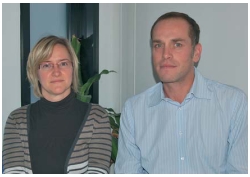
 A few months ago, IGNA won the call for tenders of the Ministry of Justice for trace analysis. Time has come for a first assessment. As one can imagine, this is a big endeavor… “It took much time and the involvement of five persons to prepare the tender. In the end, we won on the strength of our technical services, but also of our prices and lead times,” sales director Stéphane Marchand emphasizes. The objective is to expand the FNAEG [Automated National Database of Genetic Profiles] by including profiles obtained from traces taken on mass crime scenes. As a matter of fact, this definition is somewhat vague: “It is strongly advised to exclude rape cases,” expert Soizic Le Guiner points out.“These involve specific analysis techniques and often result in mixed DNA profiles, which cannot be exploited by the FNAEG.” Over the first three months, the laboratory received only 1,000 samples, and then, all of a sudden, the market took off, starting in August. “Since then, we’re receiving nearly 5,000 new requests every month: our projections have been achieved more quickly than expected,” Stéphane Marchand says.
Every piece of evidence must be individually sealed
For investigators, the procedure is simple: they have to establish a FNAEG requisition, fill up the standard purchase order available on the intranet site and enclose the pieces of evidence to be analyzed. All this can be sent by mail. “Beware, there should be only one item per seal and a maximum of three items per requisition!” Soizic Le Guiner insists. File conformity is checked upon arrival to the laboratory, which possibly contacts the requesting body in case of a problem. It is then recorded in the LIMS to guarantee its traceability and analyzed: the technical procedures used are strictly identical to those applied for all IGNA examinations, thus ensuring optimum quality. “In a great number of cases, we obtain a profile which can be loaded into the database,” Soizic Le Guiner congratulates herself. Profiles are sent to the FNAEG once a week. The requesting bodies also receive a report. If a profile has been obtained, sealed evidence residue is then sent to the central department for the conservation of biological samples (SCPPB) where it remains stored for possible counter-examinations. The other residues are returned to the requesting bodies. “It should be remembered that the cost of every analysis is taken care of by the Ministry of Justice,” Stéphane Marchand points out. “Therefore, their cost does not affect court budgets…”
From IGNA – Newletter january 2010